
Blog |
9/14/24
In the course of my research, I seem to have discovered something about 19th-century culture that no scholar has ever written about. I have seen many reports that plagiarism was rampant during that period, and many scholars take the view that it was "normal," or at least tolerated. I can prove that it was not, at least, not by newspaper editors, who kept a sharp eye out for it and denounced it in no uncertain terms! But what I'm speaking of, this morning, is specifically the habit of bragging to close friends and family about having written things that one hadn't, actually, written. Presumably, the intention was to impress them. I would never have guessed this was a "thing" in the 19th century, except that I ran across three instances. Something like this would, naturally, be kept private. So if I stumbled upon three instances, it must have been quite common!
I've already shown you one example, recently. You may have dismissed it as my fond interpretation, rather than as evidence. But what you don't know is that this may not have been so very uncommon. Here we have Margaret Fuller bragging, in an off-hand, casual way in a postscript, that not only was she newly-appointed as the literary editor of the New York "Tribune," but she was the author writing the column signed with a "star." I found, I think it was, four or five examples of her doing this.
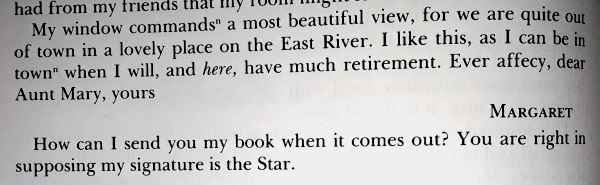
This is, simply, a lie. She was the editor, and she had Mathew Franklin Whittier writing the column for her over his own secret signature, which he had been using--including to sign reviews--for years. She apparently imagined that she and Mathew had a ghost-writing arrangement, so anything Mathew wrote for her, was hers. But it couldn't have been so in his mind, because otherwise he would not have employed this pseudonym. I gather they never discussed it--Mathew simply assumed he was writing for the "Tribune" anonymously.
Fuller, apparently, had a gigantic ego, which included an enlarged sense of entitlement.
But again, this, apparently, was not an isolated occurrence in the 19th century. So let me show you some other examples.
Mathew used the pseudonym "Trismegistus" (a reference to the ancient Greek philosopher and mythical figure, Hermes Trismegistus), four times in the 1828 Boston "New-England Galaxy," once in the June 29, 1835 New York "Transcript" (credited from the "New Haven Herald"), and once in the April, 1836 "Blackwood's Edinburgh Magazine." (The editor of the "Galaxy," Joseph T. Buckingham, all but identified him as the writer using this pseudonym in his 1852 memoirs.) When Mathew began writing for the humorous newspaper, the Boston "Carpet-Bag" in 1851, he picked it up, again. Two of the most popular characters in the "Carpet-Bag" were spin-offs from this pseudonym. After several years' research, I have no doubt whatsoever that this was Mathew's signature. Mathew was heavily invested, both financially and creatively, in this paper. In one weekly edition, I counted as many as eight of his anonymous contributions! He was also personal friends and a secret collaborator with the editor, Benjamin Penhallow Shillaber. I could write 20 blog entries on that subject. But look what Shillaber says, when writing, in his memoirs, about the core contributors for the "Carpet-Bag":
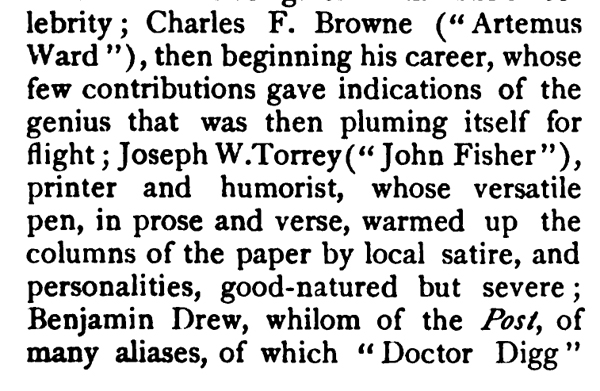
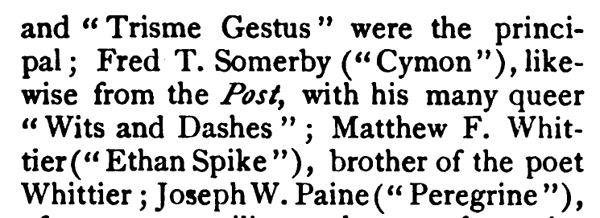
Just this small snippet is wrong, or misleading, on several counts. Charles Farrar Browne got his start in that newspaper by plagiarizing and re-writing one of Mathew's own humorous sketches. Joseph Torrey imitated Mathew's style flagrantly (and Mathew sparred with him about it, in the pages of the "Carpet-Bag"). Here, Shillaber misspells "Trismegistus" as "Trisme Gestus," and it was not written by Benjamin Drew. Finally, "Ethan Spike" was hardly the only thing that Mathew (spelled with one "t") contributed to this paper.
But let's drill down on this claim concerning Benjamin Drew as "Trismegistus." How could the editor be wrong about this? Well, in one installment of his "To Correspondents" column, he makes it clear that he often didn't know who was submitting these anonymous pieces. Mathew was notorious for not only publishing anonymously, but actually submitting anonymously. That's how Edgar Allan Poe was able to falsely claim authorship of "The Raven." The editor of "American Review," which first published it, didn't know who had submitted it.
But I didn't leave the matter there. I hired a researcher to access Benjamin Drew's private papers, which collection includes his diary and an unpublished autobiography. Neither source mentions the "Carpet-Bag," at all; and the diary (if it is complete) skips over those years, 1851-53. Moreover, he simply emerges as an unlikely character to have written the "Trismegistus" series and its spin-offs, with their sharp and yet subtle satirical edge. I could give you evidence all day. But more to the point, there is something very strange going on in this diary. On two occasions, Drew writes poems in it which will later show up in the "Carpet-Bag" under this same pseudonym, "Trismegistus"! Here, in 1849, he indicates that he has just written the poem:
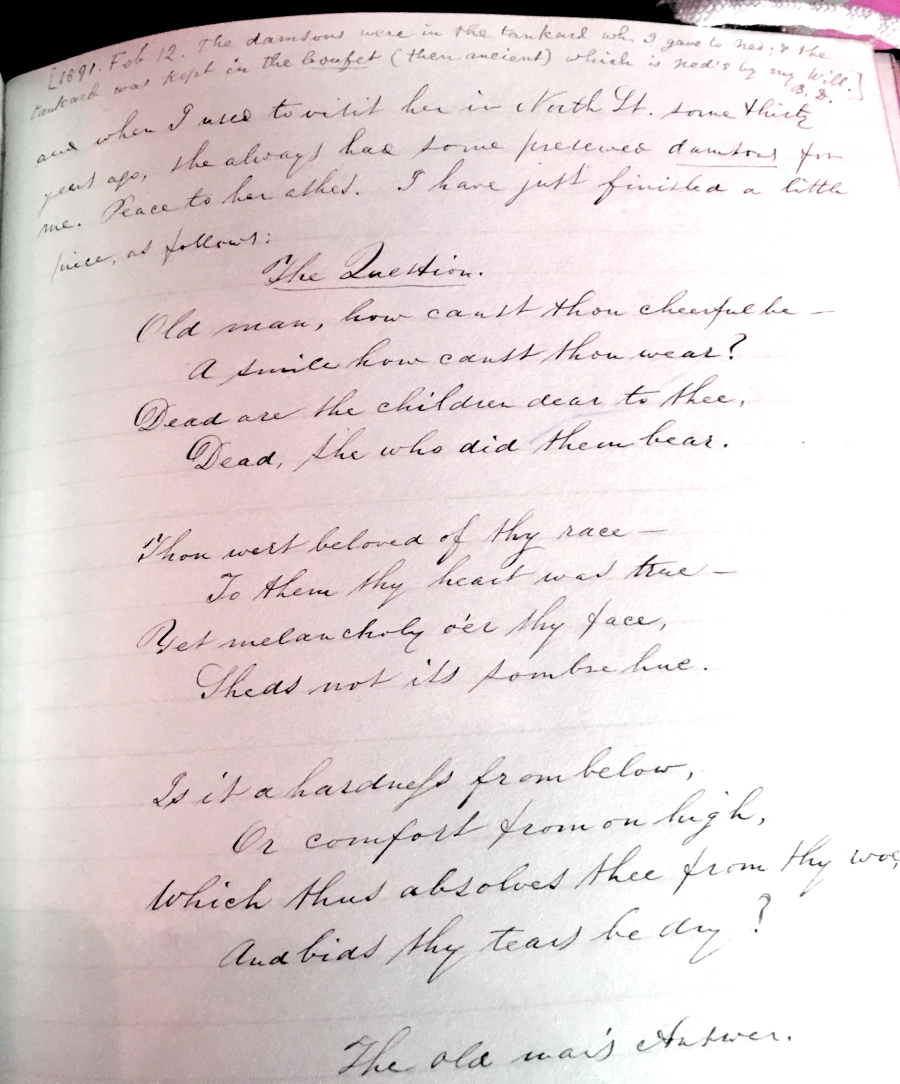
Here is the poem as it appeared two years later in the June 28, 1851 edition of the "Carpet-Bag," under the title of "Cheerfulness in Old Age," signed "Trismegistus."

Note that after Abby's death, Mathew often characterized himself as prematurely old. There is a subtle disconnect in this poem--typically (if this is meant to represent old age) an old man would not outlive both his spouse, and his children, which is to say, his entire family. But it was true for Mathew Franklin Whittier, and Mathew very often wrote, in a disguised fashion, from real life. This would not have been true for Benjamin Drew.
Without having this inside information, however, you might say Shillaber's first-hand testimony was proof positive--right? The few scholars who have looked into the matter (I only know of one) have been that sloppy. Or, it might be kinder to characterize them as naive. There seems to be a strange phenomenon in academic scholarship, that with an obscure historical figure, whatever little you can find on them, you just accept without questioning. A famous writer like Edgar Allan Poe they will dig into and argue about endlessly--but if only one scholar even bothers with someone like Shillaber, he just takes whatever Shllaber says as "gospel."
I knew this was wrong--but, how to account for it? First of all, Mathew unwisely shared his unpublished work with people. That's how Edgar Allan Poe got his hands on "The Raven" and "Annabel Lee." But as for why Drew would lie to his own diary, the explanation became apparent when I learned that in the 19th century, at least some people used to share their diaries with their family. This opens up a whole other can of worms. It means that if a man wanted to convince his wife of his literary prowess, he would steal an unpublished poem that had been unwisely shared with him in private, put it in his diary as though he had just written it, and then let his wife read it.
Quite possibly, this is how he also convinced Shillaber that he had written it, given that it had been anonymously submitted to the "Carpet-Bag." What all this means, is that Mathew's exaggerated habit of anonymity made his work a wide-open target for every plagiarist in New England, and a few overseas, as well. I am reminded of the Far Side cartoon depicting the elk with the big red bullseye on his chest, whose companion remarks, "Bummer of a birthmark, Hal."
But there was yet another instance. Mathew Franklin Whittier wrote almost 400 reviews, over his "star" signature, for the 1830-33 New York "American." They read, in style, precisely as the ones he later wrote for the New York "Tribune," which Margaret Fuller falsely claimed--oh so casually--in her letters to close family and friends. And guess who does exactly the same thing, in 1830? A writer named Charles Fenno Hoffman. Here, he is writing to his brother, George, on April 21, 1830, when he has become associated with the staff of the "American":
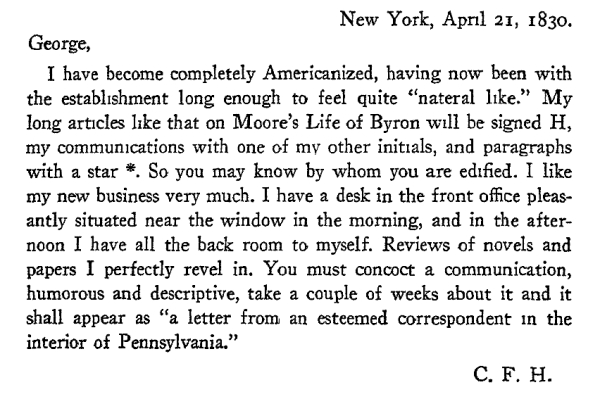
Pretty convincing, huh? It comprises the bulk (if not the totality) of Homer F. Barnes' evidence, in his 1930 dissertation on Hoffman. Hoffman said it, so Barnes believes it. But Mathew Franklin Whittier had already used this signature, fairly recently, in the August 29, 1829 Boston "Courier." Mathew, as a child prodigy, had been writing for the editor's other newspaper, the "New-England Galaxy," since 1825. Probably, he was working for this one, and wrote this one letter to the editor defending a local poet, for the "Courier." At this time, Mathew had just turned 17.
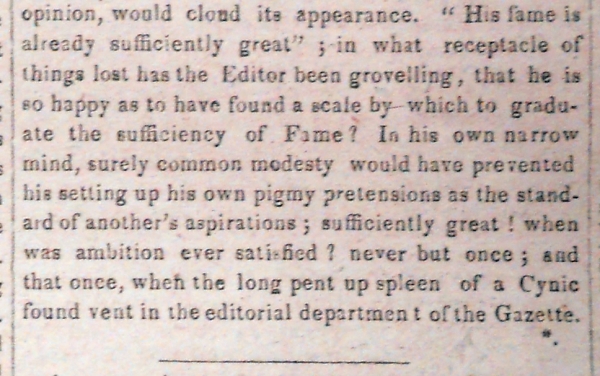
So the "star" was already Mathew's signature when he moved to New York City in late 1829, and began writing for two newspapers there--the "Constellation" and the "American." There is a smoking gun which proves that Hoffman could not possibly have been the "star"-signing reviewer in the "American," which I won't get into, here--it has to do with the "star's" protest of unsporting deer-hunting practices, as compared with Hoffman's enthusiastic endorsement of same made by him elsewhere.
So what accounts for this glaring discrepancy? The only solution I can see, is that like Margaret Fuller and Benjamin Drew, he was simply lying to his brother by way of puffing himself up. All three of these people had inferiority complexes. They were all anxious to prove to people close to them how good a writer they were. So that would be the common denominator. You might say, "If anything, Margaret Fuller had an expanded ego, not a contracted one!" But, they go together. The person who is inflating their ego, does so by way of compensation. (Remember I have a master's in counseling, so I have the academic credentials to make interpretations like this.)
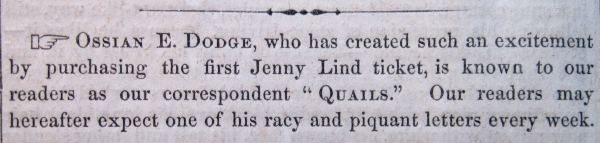
There was another example, which isn't precisely on-topic, but I'll just share it briefly. This is relevant inasmuch as it's yet another example of a lie which the one or two scholars who cared at all, simply swallowed without question. Here, editor Charles A.V. Putnam asserts, in the pages of the Boston "Weekly Museum," that entertainer Ossian E. Dodge was the author of the popular travelogue series, "Quails." He was not. That was being written by Mathew Franklin Whittier, who at the time was working under cover for the abolitionist movement--and using this public column to report his contacts! All without the pro-slavery people suspecting a thing. But one thing Mathew dared not do was to reveal his identity as the author--a reticence that Putnam and Dodge, colluding, interpreted as a weakness and took advantage of:
I want to leave you with this observation. When I say that Mathew Franklin Whittier was the author of such-and-such a piece, or a series, I have a great deal of time--and sometimes, money--invested in that conclusion. I dug very deeply into the question. On the other hand, when one or two scholars have written a paper asserting that some other person was the author, that scholar has put hardly any effort into it. He has blithely accepted whatever that person said, or wrote to a friend, as Fact. The problem is, that scholar had the degree, and he got published in a scholarly journal. He got published in the journal because he was the only one who knew anything about his subject, or cared. There was no-one to dispute his conclusions, and he was the expert by default at the time.
Which means, some very poor scholarship could still get into a journal of some kind or another, if he was the only person writing on the subject. If one wanted to be cynical, one might even suggest that it's a work-around for people who want to publish! In any case, the fact that you can find an assertion of authorship in black-and-white in a journal, doesn't necessarily mean as much as you'd think it does.
Yesterday, I received my second e-mail response from a scholar concerning Margaret Fuller and Mathew Franklin Whittier. She put me in a classical double-bind: she won't take time to read my paper on the subject, but she is challenging me for evidence. Well, very often the evidence is cumulative, which means you have to read the paper to get it. But in this particular case concerning Margaret Fuller, as I've shared with you recently, I have a couple of "smoking guns." Flat-out proof that she couldn't possibly have written at least one of the pieces she claimed, which can be given very quickly. As of this morning I haven't received a third letter. There really is no explanation for that evidence. She has two options: admit I'm right, and begin a real two-way discussion on the subject, or stop responding. We'll see which it's going to be.
Sincerely,

Stephen Sakellarios, M.S.
